Comprehensive Lighting
Services
As a professional lighting modernisation partner – in addition to supplying light sources and luminaires for office lighting, retail lighting, residential lighting, museum lighting, industrial hall lighting, LED lighting, outdoor lighting, street lighting, emergency lighting, safety lighting, exit lighting, car park lighting and other lighting areas – our lighting services also extend to related needs, such as: lighting design, lighting installation, and LED lighting modernisation.
Lighting Services
for facility managers and maintenance teams
Supply of lighting equipment with a special focus on facility managers and maintenance teams. Personal contact and full, high-quality, yet cost-effective fulfilment of any unique related needs that arise. We strive to establish a personal and long-term partnership with all our clients. Earned trust is a competitive advantage, and we do everything to achieve it.

Free site survey
Lighting survey, lighting design, lighting modernisation and professional consultancy for all our partners.
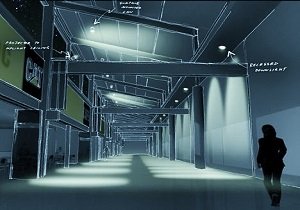
Lighting modernisation
Lighting modernisation from design to full installation. Energy-efficient luminaires and cost-effective LED solutions.

LED ROI Calculator
Calculate the payback period for your lighting upgrade or LED retrofit, including design and installation costs.
Questions by service
Pick a topic, or open the service page for the full details
Cleanroom Lighting
What is cleanroom lighting?
Cleanroom lighting is a specialised system that provides appropriate illumination in controlled environments while meeting strict hygiene requirements.
What is ISO 14644?
ISO 14644 is the international standard for cleanrooms; it defines the cleanliness classes.
What does GMP compliance mean?
GMP rules govern the quality and hygiene requirements of pharmaceutical manufacturing environments.
Why is IP65 protection important?
It prevents dust and moisture from entering the luminaire.
What are the advantages of LED technology?
It is energy-efficient, long-lasting and requires little maintenance.
What is DALI control?
A digital lighting control system that allows luminaires to be regulated intelligently.
What cleanroom classes are there?
The most common are ISO 5, ISO 6, ISO 7 and ISO 8.
Can an existing system be upgraded?
Yes. In many cases either a retrofit or a complete replacement is possible.
Why is glare-free lighting important?
It improves visual comfort and reduces the likelihood of errors.
Why is lighting design necessary?
It ensures compliance with the standards and optimal operation.
What is the benefit of lower heat output?
It can reduce the energy demand of air conditioning.
What maintenance does it require?
LED systems typically require minimal maintenance.
Can emergency lighting be integrated?
Yes, it can be integrated into most systems.
Can it be used in laboratories?
Yes — it is particularly recommended for laboratory environments.
Can it be used in hospitals?
Yes, it is suitable for many healthcare applications.
In which industries is it used?
Pharmaceuticals, healthcare, electronics, food production and R&D.
What service life can be expected?
The service life of modern LED systems considerably exceeds that of conventional technologies.
What colour temperature is recommended?
It depends on the application, but typically neutral or cool white light.
How important is CRI?
High colour rendering is particularly important in laboratories and healthcare environments.
When is it worth involving a specialist?
As early in the project as possible, so that later changes and additional costs can be avoided.
Industrial Lighting Control
What is industrial lighting control?
Industrial lighting control is an intelligent system that automatically regulates the lighting of halls, warehouses and production areas using occupancy, motion and lux sensors, in order to optimise energy consumption.
How much can be saved in an industrial environment?
In industrial facilities an energy saving of 30–40% is typically achievable through zoned control, dimming and daylight harvesting.
Is it suitable for high-bay warehouses?
Yes. With aisle-based control in high-bay warehouses the lighting runs at full output only in the aisles actually in use, which significantly reduces energy consumption.
Can it be integrated into an industrial BMS?
Yes. Industrial lighting control can be integrated into a building management system (BMS), so consumption data can be monitored and audited.
What technology does it use?
On industrial projects, digital control to the DALI Alliance standard is common, as is an integrated system based on KNX Association technology.
Lighting Control
What is lighting control and how does it work?
Lighting control is an intelligent system that automatically regulates the operation of the lighting using sensors (occupancy, motion and light sensors) and digital control protocols, optimising both energy use and operational reliability.
How much energy can be saved with lighting control?
In industrial and office environments a further 30–40% energy saving is typically achievable, particularly with zoned control, dimming and daylight harvesting.
What is the difference between KNX and DALI?
KNX, developed by the KNX Association, is a complete building automation system that integrates several subsystems (lighting, HVAC, shading), whereas DALI, standardised by the DALI Alliance, is designed specifically for digital lighting control, with addressability and dimming at individual luminaire level.
Can lighting control be integrated into an existing building automation system?
Yes. Modern lighting control systems are built on standardised communication protocols, so they can be integrated into a BMS or into existing building automation infrastructure.
What is HCL (Human Centric Lighting)?
HCL is a human-centric lighting system that dynamically adjusts the colour temperature and intensity of the light to follow the rhythm of natural daylight, supporting concentration and comfort.
Is lighting control a worthwhile investment?
On larger industrial and office projects the investment typically pays for itself within 2–5 years, through energy savings and reduced maintenance costs.
Can it also be used outdoors or for street lighting?
Yes. Adaptive outdoor lighting control works with traffic- and time-of-day-dependent dimming, remote supervision and fault monitoring.
Lighting Design & Installation
What size projects does Pannon Lighting take on?
We typically work on floor areas between 200 and 20,000 m², with no limit on ceiling height. Our lighting design work covers industrial halls, warehouses, offices, retail spaces and special-purpose facilities. We can coordinate three to four projects in parallel, backed by a proven network of subcontractors and installers.
Are you brand-independent? Which manufacturers do you work with?
Yes — our designs are entirely manufacturer-independent. We select the luminaires and control systems that best match the technical, financial and operational requirements of the project. We work with a network of European manufacturers, paying particular attention to standards compliance, warranty terms, service life and best value for money.
Do you prepare a return-on-investment (ROI) calculation and a consumption optimisation plan?
Yes. Every lighting concept we produce includes a detailed ROI calculation and an energy consumption analysis. We examine annual operating hours, electricity costs, maintenance savings and the expected payback period. Our payback calculator is also available for a preliminary estimate.
What software is used to produce the lighting designs?
Our lighting designs are produced in DIALux, where validated photometric calculations model illuminance levels, uniformity, glare (UGR), power density and energy consumption. The simulations are based on the actual geometry of the space.
What does the lighting design process look like?
The process begins with a site survey and a record of requirements, followed by standards-based photometric calculation, optimisation of the luminaire layout, development of the control concept and a cost-benefit analysis. At the end we hand over technical documentation ready for installation.
What documents do you hand over at the end of the project?
We hand over the DIALux lighting design prepared by our lighting engineer, the post-installation illuminance measurement and its report, the luminaire schedule, technical specifications, the required documentation and maintenance recommendations that help extend the life of the LED system.
Do you also check compliance with standards?
Yes. Our designs are always prepared in accordance with the applicable EN lighting standards in force, including workplace illuminance levels and uniformity requirements.
Can you help us achieve green certifications (BREEAM / LEED)?
Yes. Energy-efficient, controllable and intelligent lighting systems, together with documented savings data, directly support the credits needed for BREEAM and LEED certification.
Is maintenance and follow-up available?
Yes. For us, handover is the beginning of a long-term partnership. We provide life-cycle support in the form of monitoring, maintenance, warranty administration and recommendations for future upgrades.
Do you provide sample luminaires or trial installations?
Yes. On request we provide sample luminaires, and we carry out trial installations and on-site light measurements so that light quality, optics and visual comfort can be assessed in a real environment before any decision is made.
Do you also design integrated lighting control?
Yes. We design intelligent lighting control systems based on motion and occupancy detection, daylight sensing, time scheduling or DALI / BMS / KNX integration, in order to maximise energy efficiency.
Do you design safety and emergency lighting alongside the general lighting?
Yes. In our lighting design projects we also design complete safety and emergency lighting systems alongside the general lighting, including the photometric design of escape routes, panic lighting zones and safety signage.
Lighting Installation
What size installation projects does Pannon Lighting take on?
We typically deliver lighting installation projects with floor areas between 200 and 20,000 m², although for facilities with great ceiling height or special industrial requirements we handle other volumes as well. We have the installation capacity and the subcontractor network to coordinate several projects at the same time.
Do you take on installation only, or do you work together with the design?
We work in both models. We undertake standalone lighting installation based on existing designs, but on most projects we provide an integrated service from lighting design through to installation, which results in an implementation that is optimised both technically and financially.
In what kinds of facilities do you carry out installations?
We carry out lighting installations in, among others:
-
industrial production halls
-
warehouses and logistics centres
-
office buildings
-
commercial and retail spaces
-
multi-storey car parks
-
sports facilities
-
public institutions
-
outdoor industrial areas
What lighting systems do you install?
Our installation work covers the complete lighting infrastructure:
-
LED high-bay lighting
-
warehouse lighting with dedicated optics
-
office LED panels
-
track-mounted and design lighting
-
area and car park lighting
-
façade lighting
-
emergency and safety lighting
-
intelligent control integration
Do you also install integrated lighting control?
Yes. During installation we fit and integrate:
-
DALI control systems
-
KNX and BMS connectivity
-
motion and occupancy sensors
-
daylight regulation
-
dimming and zoned control
This enables significant energy savings and optimised operation.
What does the installation process look like?
Installation follows a structured sequence of steps:
-
Site survey
-
Installation plan and schedule
-
Installation of the luminaires
-
Electrical works
-
Control integration
-
Commissioning
-
Illuminance measurement
-
Documented handover
The work is always scheduled around the operation of the facility.
Can you work while production continues?
Yes. A significant part of our installation work takes place in operating industrial and logistics environments. We carry out the work to a schedule, in phases, and where necessary in night-time or weekend windows, so that production downtime is kept to a minimum.
Do you have liability insurance for installation work?
Yes. All our lighting installation work is carried out with valid professional liability insurance in place. This provides cover for any damage arising during installation and gives our clients financial and legal security — particularly on work carried out in operating industrial environments.
Do we receive measurement verification at the end of the project?
Yes. On completion we carry out an instrument-based illuminance measurement, checking illuminance levels, uniformity and compliance with the standards. The results are handed over documented in a formal report.
What documentation do you hand over?
As part of the technical handover we provide:
-
DIALux lighting designs
-
luminaire schedule
-
electrical documentation
-
measurement reports
-
control settings
-
maintenance recommendations
Are you a manufacturer-independent installer?
Yes. We are not committed to any single manufacturer. During installation we select the luminaires and system components that best match the technical, financial and operational requirements of the project.
Do you provide sample luminaires or trial installations?
Yes. On request we provide a sample luminaire or a trial installation, so that light quality and appearance can be checked in a real environment before the final decision is made.
Is maintenance and follow-up available?
Yes. We continue to support our partners after handover with:
-
maintenance services
-
warranty administration
-
system monitoring
-
recommendations for later upgrades
How long does a lighting installation take to pay for itself?
The payback period depends on the project, but for industrial LED upgrades it is typically between 1.5 and 4 years. We determine the exact figure with an ROI calculation based on energy consumption and operating data.
Lighting Modernisation
Why is it worth modernising conventional lighting?
One of the greatest benefits of lighting modernisation is the significant reduction in energy consumption and the optimisation of operating costs. Modern LED lighting systems consume less energy, last longer and require considerably less maintenance than conventional light sources.
Modern lighting also:
- improves the quality of illumination,
- reduces glare,
- increases visual comfort,
- supports intelligent lighting control,
- contributes to sustainable operation.
How much energy can be saved through lighting modernisation?
Switching to modern LED lighting systems generally delivers energy savings of 50–80%, and combined with intelligent lighting control the reduction in lighting energy use can in some cases reach 90–95%.
The scale of the saving depends on:
- the type of the existing system,
- the operating hours,
- the control system applied,
- how the facility in question is used.
Which lighting systems are worth modernising?
Lighting modernisation is particularly recommended for the following systems:
- fluorescent lighting,
- halogen lighting,
- conventional incandescent lamps,
- metal halide lamps,
- high-pressure sodium lamps,
- older, first-generation LED systems.
In terms of energy efficiency and operation, outdated systems often no longer meet today's requirements.
Is it worth modernising existing LED lighting as well?
Yes. In many cases it is worth modernising older LED systems too. First-generation LED lighting often:
- operates at lower efficiency,
- provides poorer light quality,
- causes more glare,
- does not support intelligent control.
Modern LED systems offer considerably better energy efficiency, longer service life and more advanced control options.
What is the service life of LED lighting?
Modern LED lighting systems can have a service life of 50,000–100,000 operating hours, several times that of conventional light sources.
This significantly reduces:
- maintenance costs,
- the need for replacements,
- the risk of operational failures.
This is a particularly important benefit in:
- industrial halls,
- spaces with high ceilings,
- warehouses,
- outdoor systems.
When should lighting modernisation be carried out?
Lighting modernisation is particularly recommended if:
- energy consumption is high,
- failures are frequent,
- maintenance costs are rising,
- the illumination is inadequate,
- glare is present,
- there is no intelligent lighting control,
- the building is being refurbished or its use is changing,
- energy efficiency and sustainability matter.
Modernisation can be especially worthwhile where daily operating hours are long.
Why is modernisation important because of the EU phase-out of certain light sources?
The European Union has already withdrawn several conventional light sources from sale, and the phase-out of further types is under way. As a result:
- replacement parts and lamps are increasingly difficult to source,
- operating costs are rising,
- sustainable operation is becoming harder to maintain.
In the long term, lighting modernisation provides more predictable operation and more secure availability of components.
Where does lighting modernisation deliver the greatest benefit?
LED lighting modernisation is especially beneficial in:
- industrial halls,
- manufacturing plants,
- warehouses,
- logistics centres,
- offices,
- shops,
- shopping centres,
- car parks,
- outdoor lighting systems,
- public institutions,
- educational facilities,
- hotels and hospitality venues.
And in every setting where energy efficiency, operational reliability and predictable long-term running matter.
What are the benefits of intelligent lighting control?
Intelligent lighting control allows the lighting to adapt automatically to:
- occupancy,
- the time of day,
- the amount of natural light,
- the particular use of the space.
Control solutions:
- reduce energy consumption,
- increase comfort,
- optimise operation.
Modern systems support, for example:
- occupancy detection,
- daylight regulation,
- DALI and KNX control,
- central lighting management.
How long does lighting modernisation take to pay for itself?
The payback of a lighting modernisation depends on many factors, but in industrial and commercial environments it can often be achieved within just a few years.
Rapid payback is supported by:
- lower energy consumption,
- reduced maintenance costs,
- longer service life,
- intelligent control,
- available subsidy schemes.
Can lighting modernisation support BREEAM, LEED or WELL certification?
Yes. Modern LED lighting and intelligent lighting control can contribute significantly towards meeting the requirements of:
- BREEAM,
- LEED,
- and the WELL Building Standard.
Appropriate lighting supports:
- energy efficiency,
- sustainable operation,
- user comfort and well-being.
What advantages does LED lighting have over conventional systems?
The advantages of LED lighting:
- lower energy consumption,
- longer service life,
- better light quality,
- less glare,
- instant switch-on,
- intelligent control options,
- lower maintenance requirements,
- reduced carbon dioxide emissions,
- more stable and reliable operation.
This is why LED lighting modernisation is today one of the most effective energy optimisation measures available for industrial and commercial facilities.
Office Lighting Control
What is the purpose of office lighting control?
The purpose of office lighting control is to increase energy efficiency and improve visual comfort through intelligent regulation of light output and colour temperature.
What is an HCL system?
HCL (Human Centric Lighting) is human-centric lighting that dynamically regulates the intensity and colour temperature of the light, following the rhythm of natural daylight.
How does lighting control work in a meeting room?
Meeting room lighting control is based on occupancy detection, pre-programmed scenes and dimming, so a different lighting setting can be applied for a presentation, a discussion or a video conference.
Is it a worthwhile investment in an office building?
In an office environment the payback period is typically between 2 and 5 years, particularly on larger floor areas.
Is it compatible with ESG and WELL?
Yes. Intelligent office lighting control supports ESG sustainability goals and can contribute towards WELL certification.
Outdoor Lighting Control
What is adaptive outdoor lighting control?
Adaptive outdoor lighting control automatically regulates street and car park lighting based on traffic, time of day and ambient light levels.
Does it reduce street lighting costs?
Yes. Significant energy savings can be achieved through scheduled dimming and traffic-dependent regulation.
Is remote supervision possible?
Yes. Modern systems can be monitored through a central software interface, with fault alerts and consumption data.
Can it be used in an industrial park?
Yes. Adaptive lighting control is particularly effective in industrial parks and logistics centres.
What technology is it based on?
Outdoor systems can be built on DALI-based dimming and network communication, integrated into a central management system.
Technologies (KNX, DALI)
What is the KNX system?
KNX, standardised by the KNX Association, is an open building automation system that allows lighting, HVAC and shading to be controlled in an integrated way.
What is the DALI system?
DALI, standardised by the DALI Alliance, is a digital addressable lighting control protocol that enables dimming and monitoring at individual luminaire level.
What is the difference between KNX and DALI?
KNX is a complete building automation system, whereas DALI is a digital protocol specialised specifically for lighting control.
When is KNX the right choice?
A KNX system is recommended when lighting control is to be integrated together with other building services systems.
Is the system scalable?
Yes. Both KNX and DALI are modular, expandable technologies with long-term support.
News
Read our lighting technology articles about LED technology, lighting modernisation, various light sources, lighting design for halls, educational institutions, shops, factories, car parks, outdoor areas, and many other topics related to lighting modernisation.
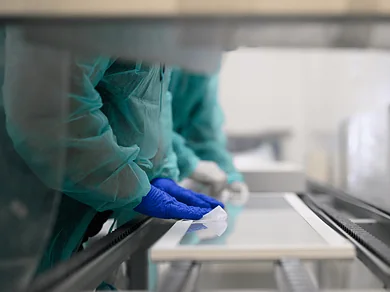
Cleanroom lighting with an antibacterial surface
Cleanroom lighting with an antibacterial surface for healthcare, laboratory and pharmaceutical environments. Luminaires with silver-ion technology to support high hygiene requirements.