The diversity of light sources in lighting technology
In the world of lighting technology we often come across terms such as…
MR16, incandescent lamp, PAR38, halogen lamp, fluorescent tube, compact fluorescent, LED lamp… but what do these terms actually mean? There is such an endless choice of products on the market these days. How do we pick the one that is exactly right for us? In this article we would like to help you understand the basic devices of lighting technology.
 INCANDESCENT LAMPS
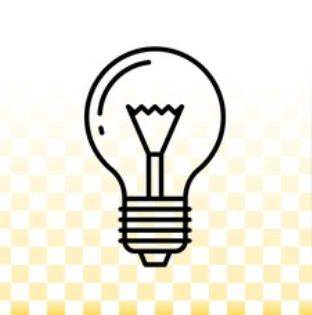
These were the first light sources to appear on the market (Edison bulbs). Perhaps that is why the incandescent lamp is the most widespread symbol of lighting. Its technology is now outdated, however, and no longer meets today's expectations, so it is used less and less. Its place is being taken by lamps using the ever more rapidly developing LED technology. There are three basic forms of incandescent lamp:
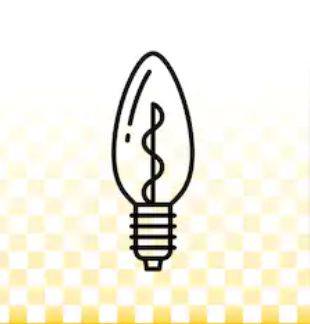
Standard (N), globe (G) and decorative (D) (candle shape, flame shape and so on)
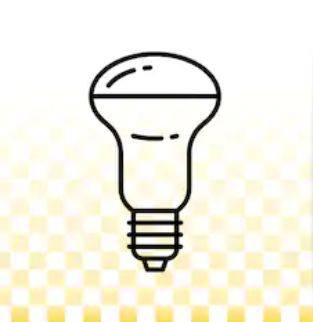 DIRECTIONAL LAMPS (reflector lamps)
A light source with a reflective coating applied to the side of its bulb, so that it emits its luminous flux directionally, serving to highlight particular objects or people (a shop window or a stage, for example). By manufacturing technology, directional lamps fall into two groups:
Reflector bulb (R) — in its manufacture the glass bulb is covered with a diffusing layer, leaving free the area through which the beam is intended to emerge. Such light sources can emit almost twice as much light as standard incandescent lamps while consuming the same amount of energy.
PAR bulb (parabolic aluminium reflector) — a directional light source with a mirrored side to the bulb. In manufacturing PAR bulbs the assembly is set into a metal cone-shaped body, onto which the pressed glass bulb face is then fused. The best-known type is the PAR 38 bulb. The number after the PAR designation refers to the diameter of the lens (38/8 inch). Its construction allows use without a luminaire, and it stands up well to mechanical impact and moisture (coloured lighting for fountains, for instance).
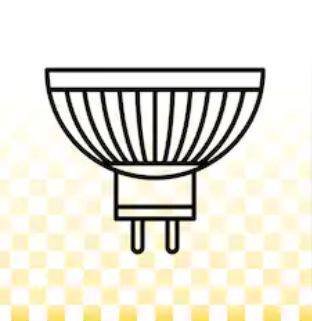
 HALOGEN LAMPS
A halogen lamp is nothing other than a tungsten filament incandescent lamp into whose bulb halogen elements or compounds have been introduced during manufacture. The presence of the halogens establishes what is known as the tungsten-halogen cycle, which allows either the light output of the source or its service life to be significantly increased. Their range of application is now very wide: car headlamps, projector lamps, studio lighting and floodlighting, though until recently they were also used indoors. Halogen light sources are available in two formats: mains voltage (230 V) and low voltage (12 V).
Mains voltage halogen lamp (230 V)
PAR16, 20, 30 and 38 bulbs are often used in spotlights and projectors.
Double-ended (R7s) and single-ended (G4, G9) lamps can be used in floor lamps, in bathroom mirror lighting and in wall-mounted luminaires alike.
Low voltage halogen lamp (12 V)
MR8, MR11 and MR16 lamps are in effect mini reflectors (multi-faceted reflectors) that emit excellent light for their small size.

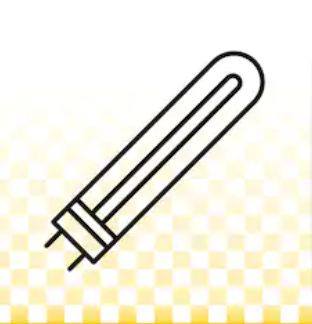
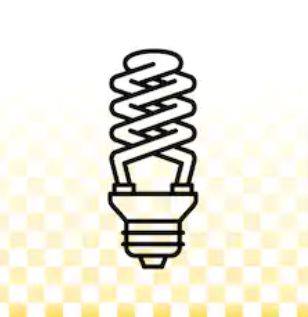 FLUORESCENT TUBES, COMPACT FLUORESCENT LAMPS
A fluorescent tube is a low-pressure discharge lamp filled with mercury and an inert gas, in which the so-called resonance lines in the ultraviolet range of mercury are predominantly excited; the resulting UV radiation, invisible to the naked eye, is converted into visible light by a phosphor coating applied to the inner wall of the tube. Its good luminous efficacy (60–90 lm/W), long service life (10,000 hours) and wide range of colour temperatures (2700 K – 6500 K) make it primarily the most economical light source for interior lighting. Commercially available fluorescent tubes fall into two large groups: the conventional (double-ended, linear) type and compact fluorescent lamps.
Besides the conventional types, tubes with reflector bulbs, coloured tubes and tubes for other special purposes are also manufactured (for lighting greenhouse plants, for example).
The most commonly used fluorescent tubes today are the T8 and T5 types. As with PAR lamps, the number in the designation of tubes marked with a T (for tube) refers to the diameter of the tube, equal to one eighth of an inch multiplied by the number given (the diameter of a T8 tube, for example, is 8/8 inch, that is 26 mm). These are used in place of conventional lamps.
This type of lamp consumes 20–30% less energy than a conventional incandescent lamp for the same light output, and its service life is twenty times longer. Fluorescent tubes are available in a number of formats.
 HIGH-PRESSURE DISCHARGE LAMPS
High-pressure discharge lamps are a light source that emerged in the course of the evolution of lighting technology. Their prototype is the mercury vapour lamp, now considered obsolete. This was the first high-pressure discharge lamp, and it gave rise to the sodium lamp and the metal halide lamp, both still widely used. It is these last two we will say a few words about here, since these technologies are still alive and are used particularly in outdoor lighting.
HIGH-PRESSURE SODIUM LAMP
The high-pressure sodium lamp (commonly referred to in Hungary simply as the sodium lamp) is a high-pressure discharge lamp in which the light is produced predominantly by the excitation and radiation of sodium vapour at a partial pressure of the order of 10 kPa.
Compared with the mercury lamp it is far more economical, and it is the recommended light source for outdoor areas and for interiors with lower colour rendering requirements. Its service life is very long — 28,000 hours for the standard type. The high-pressure sodium lamp emits a characteristic yellow light, hence its low colour temperature (2000 K). In recent years, thanks to development on several fronts, types with improved colour rendering, a whiter light and a built-in igniter have also appeared.
 METAL HALIDE LAMPS
In the manufacture of metal halide lamps, halogen compounds of various rare earth metals are added to the mercury. These improve both the luminous efficacy and the colour rendering of the lamp. Standard types have a service life of 8,000–10,000 hours and a luminous efficacy of 60–100 lm/W. The arc tube is generally made of quartz, though metal halide lamps with ceramic arc tubes have appeared more recently. Their wide range includes reflector-bulb, short-arc, double-ended and instant restrike types, among others. One of the newest developments is the xenon-filled metal halide car headlamp. They are best used where both high luminous flux and good colour rendering are required (stadiums, TV and film studios, feature lighting and so on). For building lighting purposes, the more recently developed versions rated between 50 and 150 W are particularly suitable, and can be used for a variety of decorative and accent lighting tasks.
 LED LAMPS (light emitting diode)
An acronym derived from “light emitting diode”. It is a semiconductor-based light source. The light-emitting diode is a semiconductor device that converts electrical energy directly into light, without intermediate heat energy. The light emitted by an LED lamp can be red, orange, yellow, blue, violet, pink or white. The colour of the light depends on the materials and the technology used in manufacturing the LED lamp.
Light emission from conventional light sources (incandescent lamps, fluorescent tubes, halogen lamps and so on) is based on the principle that a heated object emits thermal radiation. This process, however, radiates a great deal of heat: 95% of the energy consumed is nothing but heat.
With an LED lamp, the amount of light emitted involves far less heat loss, and its service life is many times that of lamps using conventional technology.
Today LED lamps are widely available in every colour and form, and they are set to replace outdated lighting technologies step by step and drive them from the market.
#lightingtechnology #lightingmodernisation #lightingdesign #LED #lightsource