Determining the service life of an LED
When buying a light source, expected service life is the most important factor for the customer after price.
Service life is affected by several factors. In higher-output LEDs, inadequate cooling causes the majority of failures, but even with adequate cooling a long LED service life can only be guaranteed if the driver also stands the test of time. Modern drivers are extremely complex. A great many technologies are built into them, from thermal sensors to the controller, and each can be prone to failure. To achieve the maximum service life from LEDs it is therefore important to work with drivers that are of good quality and that can be replaced independently of the LED diode should they fail.
To calculate service life we also have to be clear about what we mean by the end of life. With conventional bulbs this moment can be pinpointed exactly, by the tungsten filament breaking; with LEDs it is rather more complicated.
For LEDs the stated service life is generally a very high figure — we are talking about between 50,000 and 80,000 hours. Fifty thousand hours corresponds to roughly 5.7 years of operation, so manufacturers could not test individual LEDs through to the end of the cycle even if they ran them 24 hours a day. They had to find another way of establishing the rated service life: they estimate it.
(Even at 24 hours of use a day, manufacturers have no way of testing to the end of the cycle, so they must resort to another method: estimation.)
Under the IES LM-80 standard, manufacturers age and examine what is known as an LED population (a sample of the order of 100 units) over 6,000–8,000 hours, and estimate the expected service life of the LEDs on the basis of the changes observed during that time. The method of estimating service life is set out in the US standard IES TM-21. The measured changes in the parameters of the LEDs aged in this way determine how the expected service life of the given LED type is to be estimated.
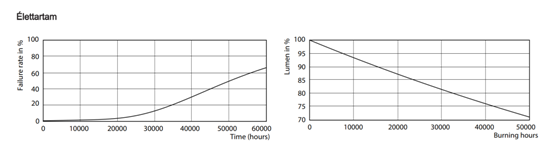
As we can see, the end of life cannot be pinpointed exactly in this case. Taking account of the fact that LEDs emit progressively less light as operating hours accumulate, a threshold has to be defined at which the light source can be considered to have failed. This is the point at which output falls below 70% of the initial luminous flux. The relevant information can be found in the manufacturer's
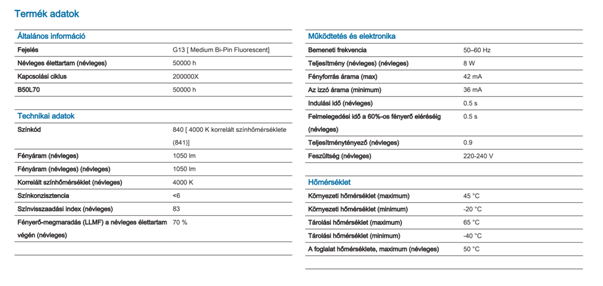
product data sheet, in the form of Bxx-Lyy figures, where Bxx denotes the percentage of failed lamps and Lyy the extent of the decline in initial luminous flux. To take a concrete example: if a data sheet states B50L70 50,000 h, this means that after 50,000 operating hours at least 50% of the LEDs will have degraded to the point of emitting less than 70% of their luminous flux.
#lightingtechnology #lightingmodernisation #lightingdesign #LED #halllighting #industriallighting