Integrated LED luminaires: pros and cons
Ever since LED light sources began to gain ground in the general lighting market,
many luminaire manufacturers began building LED lamps directly into their products, alongside their conventional fittings with replaceable bulbs and fluorescent tubes.
In 2017, 70% of the domestic lighting market involved either integrated LED luminaires (often referred to as LED light fittings) or so-called retrofit LED luminaires used with replaceable LED bulbs or tubes. In that year the latter still accounted for the larger share of LED light source sales, but since then integrated LED lamps have increasingly outpaced retrofit types, and by 2022 integrated LEDs were likely to be in the majority.
Although building LED light sources into luminaires has many advantages, the lighting industry has to face the problem of getting integrated LED luminaires widely accepted by consumers.
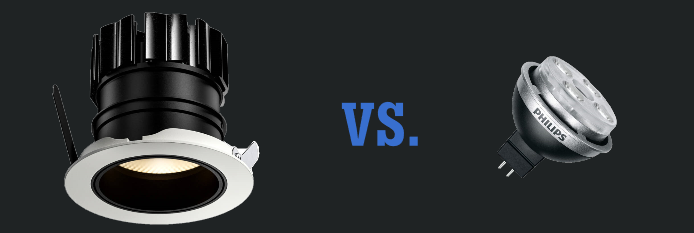
How did LED lamps revolutionise the lighting market?
For almost a century, luminaires and light sources for domestic lighting were in most cases manufactured as two separate products. This way of making them was entirely justified in Edison's day, and indeed at the very start of the twenty-first century, because back then the most common light sources — bulbs, fluorescent tubes and the like — had a short service life compared with LEDs.
What is revolutionary about LED lighting lies not only in the energy efficiency of LEDs but also in their remarkably long life. While halogen bulbs generally last only around 2,000 hours (barely a year at a few hours of use a day), LED lighting lasts 50,000 hours or more, which at the same rate of use can mean a difference of a decade.
That a light can remain serviceable for decades is still hard for many of us to imagine, but it is precisely this property that is transforming the lighting industry. Whereas halogen bulbs, with their short life, prompt regular repeat purchases like so many other household items, LEDs allow a lamp to keep working for years after installation — much like a boiler or an electric cooker. And if an LED light source lasts that long, building it into the luminaire as a permanent component starts to make sense.
Why do most manufacturers integrate LED lamps into luminaires?
Beyond the fact that they can, there are several compelling reasons why luminaire manufacturers are keen to integrate LEDs into their products:
- the added value of the fitting
- new design possibilities
- optimisation of the light source
Luminaire manufacturers have a strong incentive to integrate LEDs, since doing so can increase the value of their products. As long as they can build the LEDs in efficiently without adding too much to production costs, combining the value of the light source and the luminaire yields a significant net gain.
Integrating LED lamps also opens up new possibilities in luminaire design. Over the past century, luminaire housings had to be dimensioned to accommodate large bulbs and fluorescent tubes. LEDs, by contrast, are compact and can also be used in modular units in an array arrangement, making countless new styles possible.  It is not yet possible to say what new designer solutions will appear in decorative fittings, but among the more practical options many manufacturers have already begun to emphasise the slim profile of some of their products, as in the design LED lamp shown here.
Building LEDs into luminaires also allows manufacturers to optimise the compatibility and operation of every component of the product, including the light source. LED lighting uses a complex set of technologies and often includes intelligent control capabilities, so many luminaire manufacturers optimise how the LEDs connect and interact with the rest of the fitting.
Some potential pitfalls of integrated LED luminaires
The growing spread of integrated LED luminaires raises a number of potential problems, particularly for consumers:
- The LEDs impose an expiry date on the luminaire.
- Replacing a failed LED can be difficult.
- Current warranty cover can be disappointing for consumers.
Although LEDs can last as long as a boiler or an electric cooker, once the light source is built into the luminaire the life of the resulting product is determined by that light source. However serviceable the fitting may be, if the light source fails — and the reverse is equally true — the whole product has to be replaced. Consumers generally tend to assume that their light fittings have a more or less indefinite life as long as the bulb inside is replaced from time to time. Buying integrated LED lamps therefore carries a degree of risk. While in theory an LED light source can run for decades without maintenance, product defects and failures do occur. So when the LED reaches the end of its life — whether after decades or after only a few years — it is not just the failed light source but the entire fitting that becomes scrap.
So what happens if an LED luminaire goes dark after five years because one of the LEDs fails? Electricians generally offer to replace the light source and provide luminaire repair services, but given the diversity of the LED lighting industry — which does not always adhere to the standardisation of the conventional lighting market — the replacement LED module may not be available at a reasonable price. In fact, replacing the light source is very likely to cost more than replacing the entire luminaire.
Even if repair services and a replacement module could be found at a sensible price, the warranty on luminaires often runs for no more than five years (and a warranty beyond five years significantly increases the original price of the fitting), potentially leaving consumers trapped by the cost of repairing an integrated LED luminaire. The buyer therefore has to decide between replacing the light source more often with retrofit LEDs, which generally carry a one- to two-year warranty, and opting for an integrated LED luminaire with a much longer warranty that requires no maintenance for the whole of its operating life.
LED lighting is helping us make great strides in energy efficiency, and it offers countless opportunities to create lighting that is far more comfortable and more attractive than anything available in the Edison era. It remains unclear, however, how readily consumers will accept integrated LED luminaires, given how quickly the market has been revolutionised.
#lightingtechnology #lightingmodernisation #lightingdesign #integratedled
If integrated LED luminaires have caught your interest, or if you have any questions, do get in touch and we will be glad to help.