Lighting museums and exhibition spaces (2019-04-03)
Art inspires, unsettles and prompts us to think, to contemplate and to reflect…
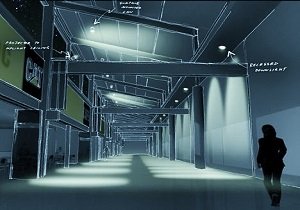
or simply entertains. Just as art and works of art are many and varied, so the presentation space suited to them and its lighting cannot be one and the same. Exhibition rooms call for very particular lighting concepts, because it is not enough for the lighting to provide sufficient light for viewing the works and to create the right atmosphere in the space: it must also do no harm to the artworks themselves. In museums and exhibition spaces, light and art are inseparably connected. The impression an exhibition makes on the viewer depends heavily on the lighting. A well-considered lighting design has to be based on the structure of the building, the layout of the room and the placement of the exhibits.
When designing the lighting of exhibition spaces it must also be borne in mind that these spaces are often rearranged and the exhibits changed, so the lighting solutions have to be extremely flexible and adaptable. Track systems with adjustable spotlights, or freely repositionable suspended directional spotlights and luminaires, serve this purpose admirably.
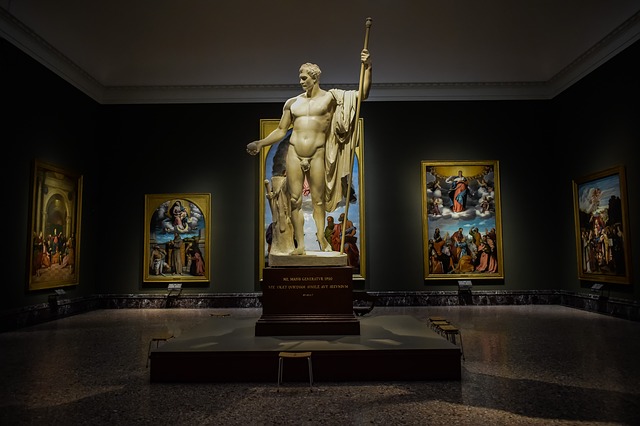
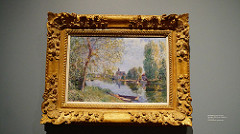 Optimal exhibition lighting requires a carefully judged mixture of diffuse and directional light. Diffuse light is best for lighting the room itself, since it radiates in every direction and casts almost no shadow. Directional light is then used to highlight individual exhibits. Spotlights and downlights put the pieces on display at the centre of attention and emphasise form, structure and material. The lighting of artworks has to be matched to the scale of the exhibition: larger pictures and objects need more or stronger light than smaller ones.
It is important that neither the room lighting nor the lighting of the objects should disturb the visitor's view of the exhibition. Paintings should therefore never be lit directly, as disturbing reflections can occur. When lighting a work, irritating shadows and light patterns on the walls and ceiling must also be avoided.
Finding a professional solution matters not only for the sake of the right atmosphere and the flawless lighting of the exhibits, but also for preserving the condition of the works — whether we intend to use artificial or natural light in the exhibition's lighting design. Both natural and artificial light contain radiation components that can damage artworks over the longer term. The harmful effect works by the energy carried by the radiation penetrating the material to a greater or lesser degree, altering its physical and chemical structure and condition and accelerating the processes by which it changes. Radiation is particularly damaging in the visible blue range and in the UV range below it, which the eye can no longer perceive. Objects can be protected from the harmful effects of radiation with filters placed in the path of natural light, and with a suitable choice of light source in the case of artificial lighting.
A research group at the Technical University of Darmstadt recently examined this problem. The researchers studied 118 different light sources (including daylight, LEDs, incandescent lamps and compact fluorescent lamps) on the basis of the spectral distribution of their radiant power.
The study concluded that LED lighting is the most suitable for artworks, since LEDs have almost no UV component and their radiation component in the blue range is also considerably lower than that of other light sources. White LEDs, for example, emit even less blue radiation than natural daylight. The advantage of LEDs in museum lighting is therefore not only that they are more economical, that they can be used flexibly in complex lighting systems, or that models with excellent colour rendering and a rich spectrum are available — they are also of outstanding importance for conservation. Converting museum lighting to LED may well be the ideal solution for the future.
#lightingtechnology #lightingmodernisation #lightingdesign #LED #museumlighting #gallerylighting #exhibitionlighting #LEDconversion #museumLEDconversion
If converting or modernising museum lighting to LED has caught your interest, or if you have any questions, do get in touch — we can help you all the way from design to installation: