Spatial uniformity of illuminance
What does spatial uniformity of illuminance mean, and why does it matter so much?
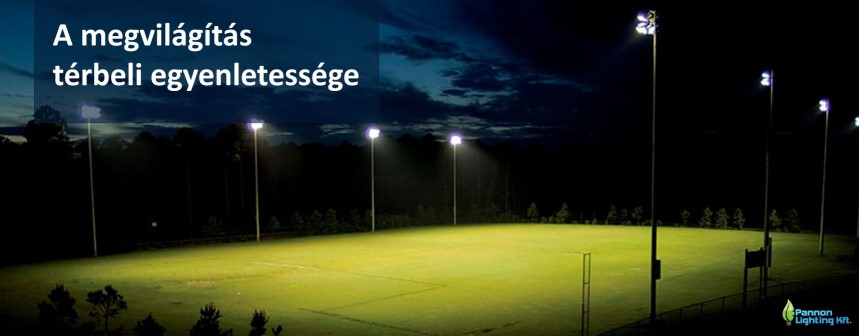
Whether the task is to light a supermarket car park, the storage area of a logistics centre, a workstation on a production line or the pitch of a stadium — to 20, 200, 500 or 2000 lux — without adequate spatial uniformity even the most expensive investment can easily turn into a nightmare. Poor uniformity of illuminance causes discomfort in the short term, and in the long term it can even lead to deteriorating eyesight.
Let there be no misunderstanding: maintaining the right illuminance level does matter, and most of our clients already know what standard-defined “lux” figure their facility needs. But the closely related requirement of uniformity is only very rarely mentioned. Many lighting companies build on this to produce apparently correct, well-documented calculations, while masterfully saying nothing about the unacceptably low uniformity values that appear — or rather do not appear — in their designs.
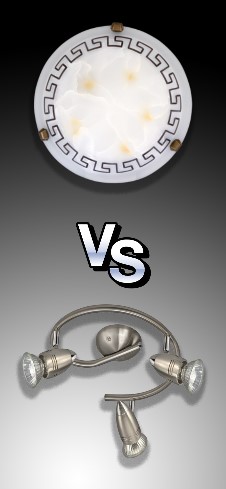 Take my own case as an example. Ceiling spotlights appeared in the early 2000s and then began to spread like wildfire. In the lighting department of every DIY store, two-, three- and five-arm ceiling spots gleamed by the hundred. That was all it took: my father immediately bought a decorative three-arm spot with 50 W halogen lamps for my room, to replace the old 60 W socialist-era fitting.
Common sense said that 3 × 50 watts is more than 60 watts, and there was no arguing with that. Being a good handyman, my father swapped the fittings over quickly. And then all that joy evaporated the moment we switched the light on. Instead of the pleasant, even half-light the little 60 W bulb had provided, the three spots lit up three separate points of the room like three separate torches.
A pity my room had four corners — so I got to look at that uneven lighting for another ten years. On the bright side, at least the walls needed repainting less often. :-)
1. The familiar wrong method
Illuminance (symbol E, unit lux, lx) is easy to establish with a simple light meter. Many a “specialist” goes out to the area to be surveyed, switches on their light meter — or, in the worse case, an app downloaded to their phone — reads an X-Y lux figure off the device, and on that basis declares that this entire hall, this whole corridor and so on has X-Y lux.
The problem is that the standard always specifies a requirement for average illuminance (Eav) and for spatial uniformity. The method described above can only determine the illuminance at one given point, disregarding the examination of uniformity entirely.
2. Determining spatial uniformity of illuminance: the point-by-point method
Indoors or out, anyone claiming to be a lighting specialist can only provide a credible measurement report by using the point-by-point method. The essence of this method is to lay a spatial grid over the area under examination — typically a 1 × 1 metre raster — and to record the illuminance (E) at each point of the grid in turn.
The spatial uniformity values (e1, e2) can be calculated as follows:
e1 = Emin/Eav
e2 = Emin/Emax
where Emin is the lowest measured value, Emax the highest, and Eav the average.
Most standards set requirements only for e1. Although specifications for e2 do exist, its direct effect on visibility and on physiology is disputed. The calculated values of e1 and e2 fall between 0 and 1. It follows that the closer the value is to 1, the better the spatial uniformity of the illuminance — that is, the quality of the lighting.
3. Good and bad uniformity of illuminance
In the lighting design of two similar football pitches, whether uniformity is examined or ignored can make a considerable difference to the end result:
Let us start with the cautionary example:
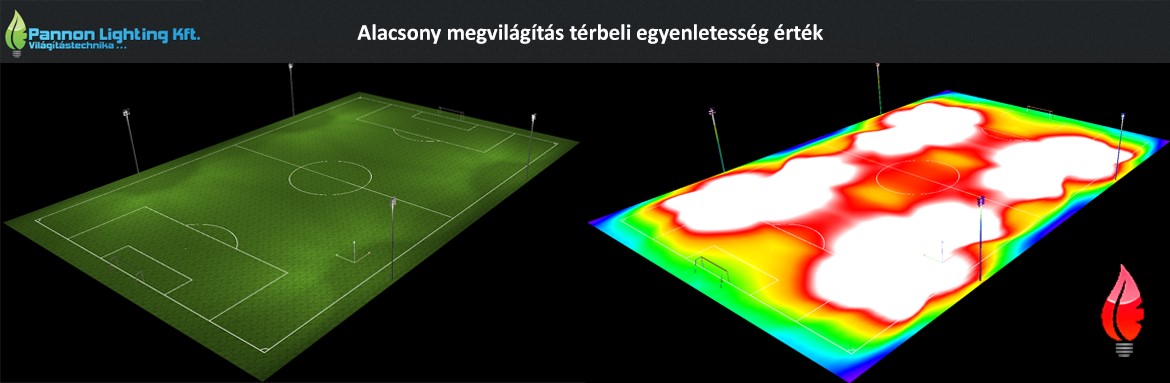
The unevenness of the lighting in the image above is visible to the naked eye. This poor result is due partly to the small number of luminaires used and partly to masts designed too low.
And the good solution:
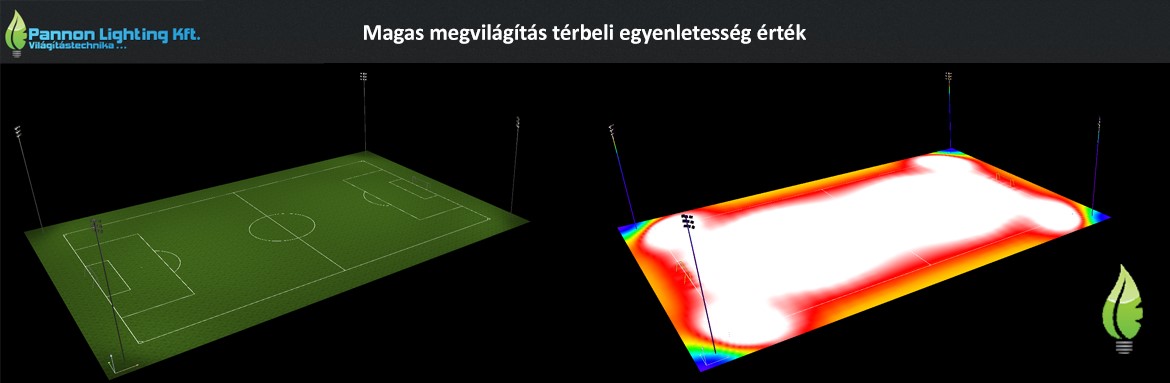
With correctly chosen luminaire optics and sufficiently tall masts, high-quality projects can be delivered not only on the drawing board but in real life too.
One reason exceptionally good uniformity is needed at sports facilities is so that players' eyes do not have to adapt continuously to changing light conditions. Where poorly designed lighting leaves darker and lighter patches across the area, the eye is constantly trying to compensate for the difference in brightness.
As a result the eye is never perfectly focused, and it tires very quickly. Properly designed, even illumination of the pitch avoids this constant strain on the eye, allowing much greater concentration and better performance. On top of all these benefits, the visual experience for spectators improves too.
In an office setting, paying attention to uniformity during lighting design lets us provide lighting that does not strain the eyes, helps avoid fatigue and errors, and can also increase employees' productivity and sense of security.
4. Different uniformity requirements
What are the lighting requirements laid down by the standards in different applications?
Sports facilities:
For football stadiums the governing standard is set by UEFA, as follows:
Class III (international matches) Eav = 750 lx e1 ≥ 0.7
Class II (national league) Eav = 500 lx e1 ≥ 0.6
Class I (training pitches) Eav = 200 lx e1 ≥ 0.5
The uniformity requirement rises with the level of the events a given pitch hosts. So while designing the lighting for a training pitch takes an hour or two, the lighting design for the playing surface of a stadium hosting international matches  can take days or even weeks.
Commercial and industrial facilities:
Airport: e1 = 0.2–0.3
Runway: e1 = 0.3–0.5
Warehouse: e1 = 0.4–0.6
Car park: e1 = 0.4–0.5
Office: e1 = 0.4–0.6
Port: e1 = 0.3–0.4
Motorway: e1 = 0.4–0.6
In the light of the examples above, our advice is that whenever a lighting investment is made, the spatial uniformity of the illuminance should be kept in view alongside the other factors during the design — so that the end result is excellent not only in value for money but in functionality too. If we can help you with lighting design, lighting modernisation or installation, do get in touch:
#lightingtechnology #lightingmodernisation #lightingdesign #sportslighting #uniformity #footballpitchlighting